
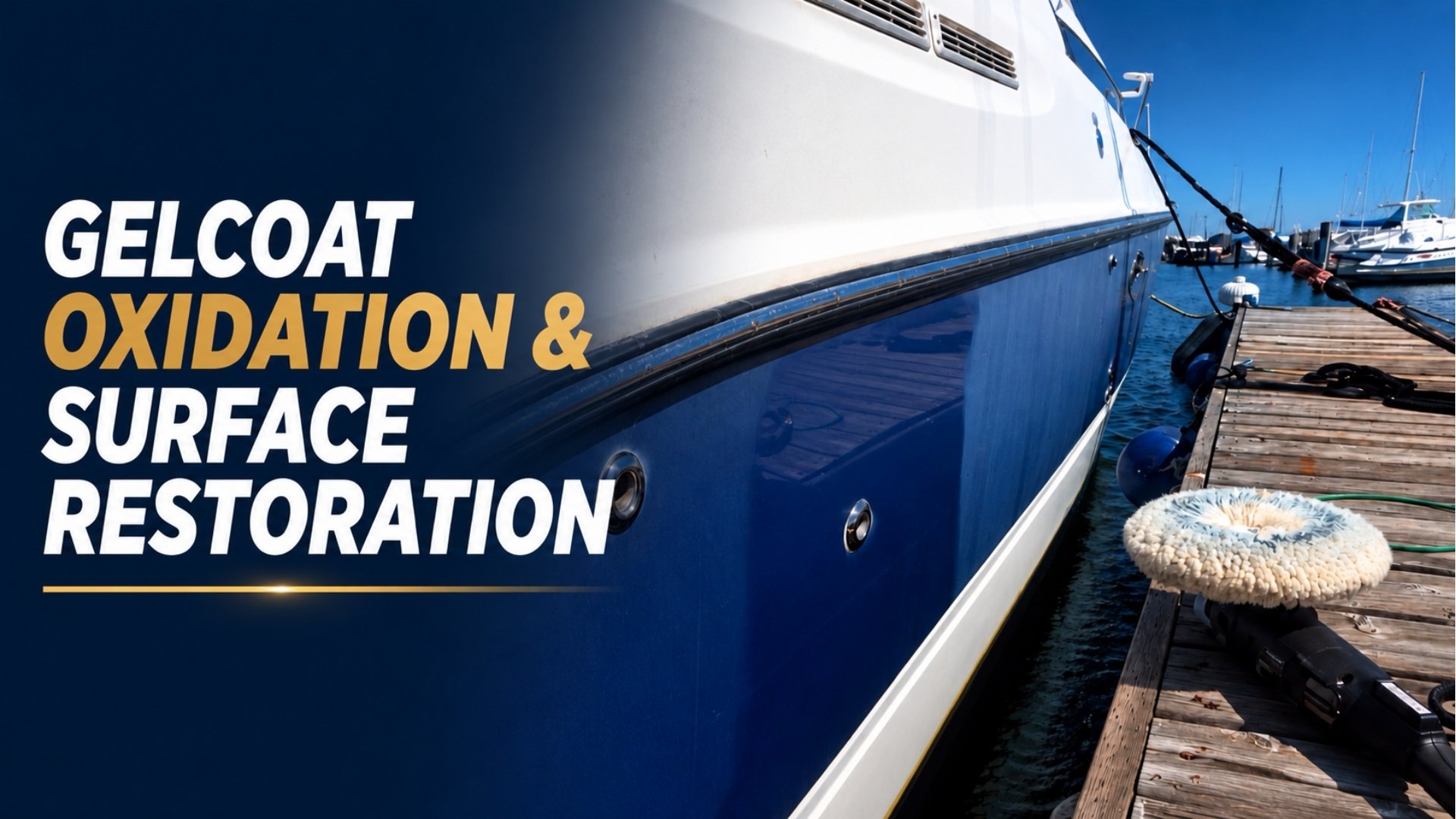
Gelcoat Oxidation Removal and Color Restoration
Does Your Boat Look Cloudy, Dull, or Covered in White Chalky Powder?
Understanding Oxidation and Contamination
Why Proactive Care Helps Protect Your Gelcoat
Gelcoat oxidation is the gradual breakdown of the exposed gelcoat surface caused by repeated UV exposure, weather, moisture, saltwater air, and environmental contamination. As the surface resin weathers, gelcoat can lose gloss and color, become chalky, and develop a more porous, uneven surface.
Wax can temporarily improve appearance and provide surface protection, but it does not remove established oxidation. Restoring weathered gelcoat generally requires mechanical surface correction using the appropriate compounds, pads, tools, and refinement steps for the condition of the vessel.
For more than 34 years, our family-owned mobile marine detailing team has worked with light, moderate, and heavily weathered gelcoat throughout Puget Sound. The goal is to remove the damaged surface material as safely and conservatively as practical, improve color and clarity, and achieve the best finish the vessel’s existing gelcoat condition will reasonably allow.
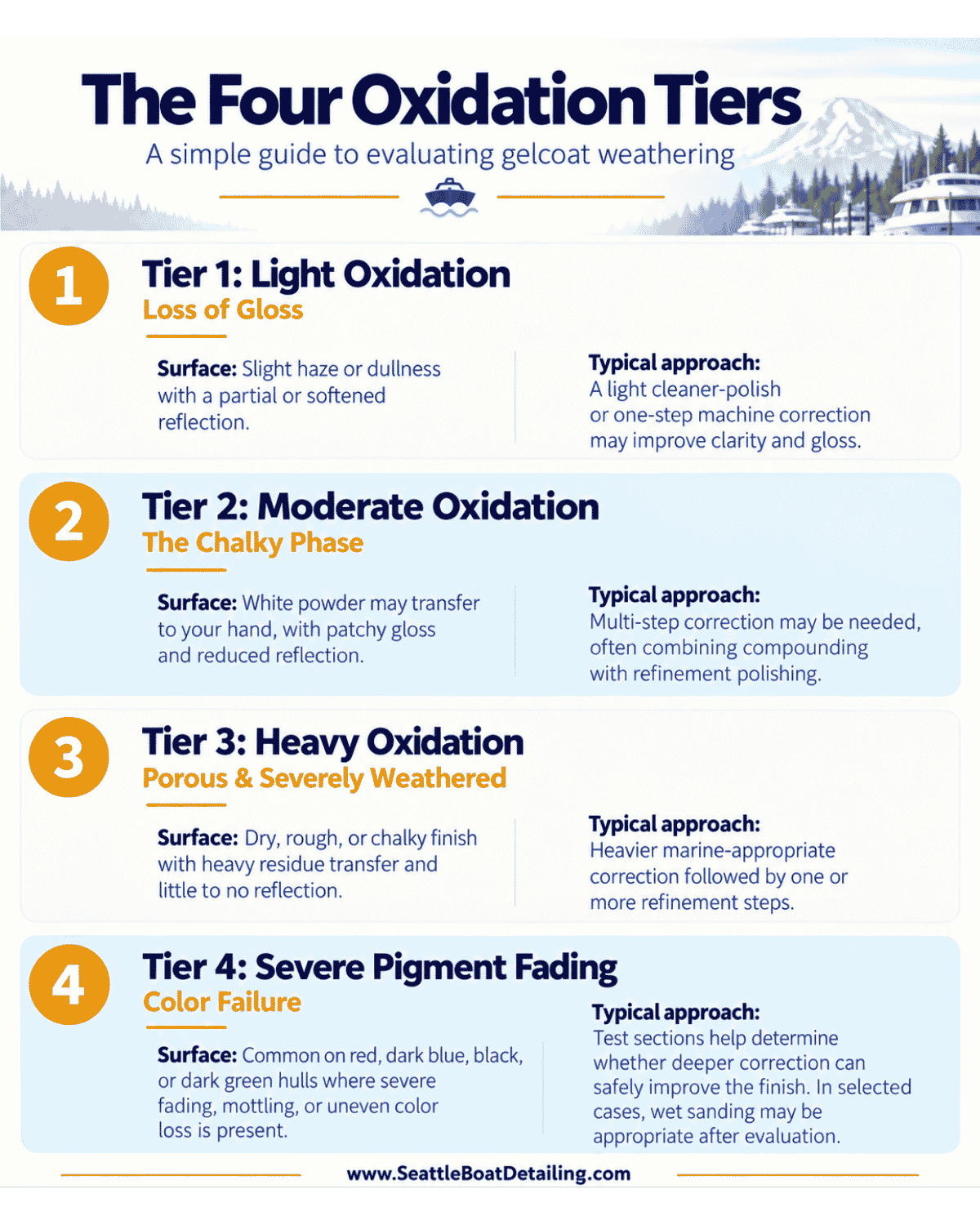
Understanding Your Vessel’s Oxidation Level
Every boat’s gelcoat weathers differently based on age, color, storage, previous correction work, maintenance history, and sun exposure. We evaluate the surface before determining how aggressive or conservative the correction process should be.
When Wet Sanding
Is or Isn’t Necessary
Many boat owners assume heavily oxidized gelcoat automatically requires wet sanding. Wet sanding is a legitimate correction technique, but it also removes material and should be used only when the condition of the surface warrants it.
Modern marine compounds, micro-abrasive technology, pad systems, and multi-stage machine correction can often address substantial oxidation without immediately moving to sanding. We begin with the least aggressive process that is appropriate for the condition and evaluate how the gelcoat responds before escalating the correction method.
When wet sanding is appropriate, it should be approached carefully and only after considering the vessel’s gelcoat condition, color, previous correction history, edges, contours, graphics, and the realistic finish that can be achieved.
Beyond Oxidation
Industrial Fallout, Rail Dust &
Environmental Contamination
Oxidation is not the only condition affecting exposed gelcoat. Boats can collect industrial fallout, tree sap, airborne pollutants, transport contamination, and microscopic metallic particles from nearby roads, rail lines, boat yards, and other coastal environments.
These tiny metallic particles can lodge in and on the gelcoat surface and oxidize, creating pinpoint orange staining. Ordinary boat soap may not remove embedded contamination, especially after it has had time to react with the surface.
Left untreated, contamination can contribute to ongoing staining and surface deterioration. The appropriate cleaning and decontamination process depends on the type of contamination and the condition of the gelcoat underneath it.
Signs Your Gelcoat May Need Professional Attention
- Chalky White Residue: Wiping your hand across the hull leaves a white, powder-like film.
- Faded or Uneven Color: The original color appears dull, washed out, or inconsistently faded.
- Rough or Gritty Surface: Embedded fallout and contamination make the surface feel less smooth or slick.
- Tiny Orange Rust Spots: Small metallic particles have oxidized and created pinpoint orange staining.
New-Vessel Contamination
Even newly delivered boats can arrive with transport fallout, metallic contamination, water spotting, and environmental residue. Establishing a clean baseline before adding wax, sealant, or ceramic protection helps ensure contaminants are addressed before they are sealed beneath a protective product.
Restoring the Waterline
Safely Addressing Scum Lines
& Mineral Buildup
Saltwater exposure, lake tannins, minerals, organic residue, and repeated wet-and-dry cycles can leave yellowing, dark scum lines, or stubborn deposits along a vessel’s waterline. These stains can remain even after routine washing.
Removing waterline staining requires matching the cleaning chemistry and mechanical process to the type of buildup and the condition of the gelcoat. Improper chemical selection, concentration, dwell time, or application can dull or damage the finish, especially on already weathered surfaces.
We use gelcoat-appropriate cleaning and decontamination methods and, when needed, follow with machine polishing or correction to improve clarity and restore a more uniform finish. The final result depends on the depth and age of the staining and the condition of the underlying gelcoat.
Protecting Your Vessel
Marine Gelcoat Requires Marine-Specific
Skills, Products & Techniques
Boat gelcoat and automotive clear coat are different surface systems and should not automatically be treated with the same products or techniques. Automotive products and methods are not automatically appropriate for marine gelcoat. Marine surfaces require compounds, pads, cleaners, protective products, equipment, and correction methods selected for the material, condition, and level of oxidation being treated.
Proper gelcoat correction also involves managing machine speed, heat, pad choice, compound cut, edges, contours, painted areas, vinyl graphics, and final refinement. The same process should not be applied to every boat simply because the surface looks dull.
Decades of hands-on marine detailing experience help our team determine how aggressively or conservatively a surface should be corrected based on its actual condition. We use marine-appropriate products and equipment selected for the surface being treated rather than relying on a one-process-fits-all approach.
Honest Evaluations
What Can Be Restored vs.
What May Need Replacement
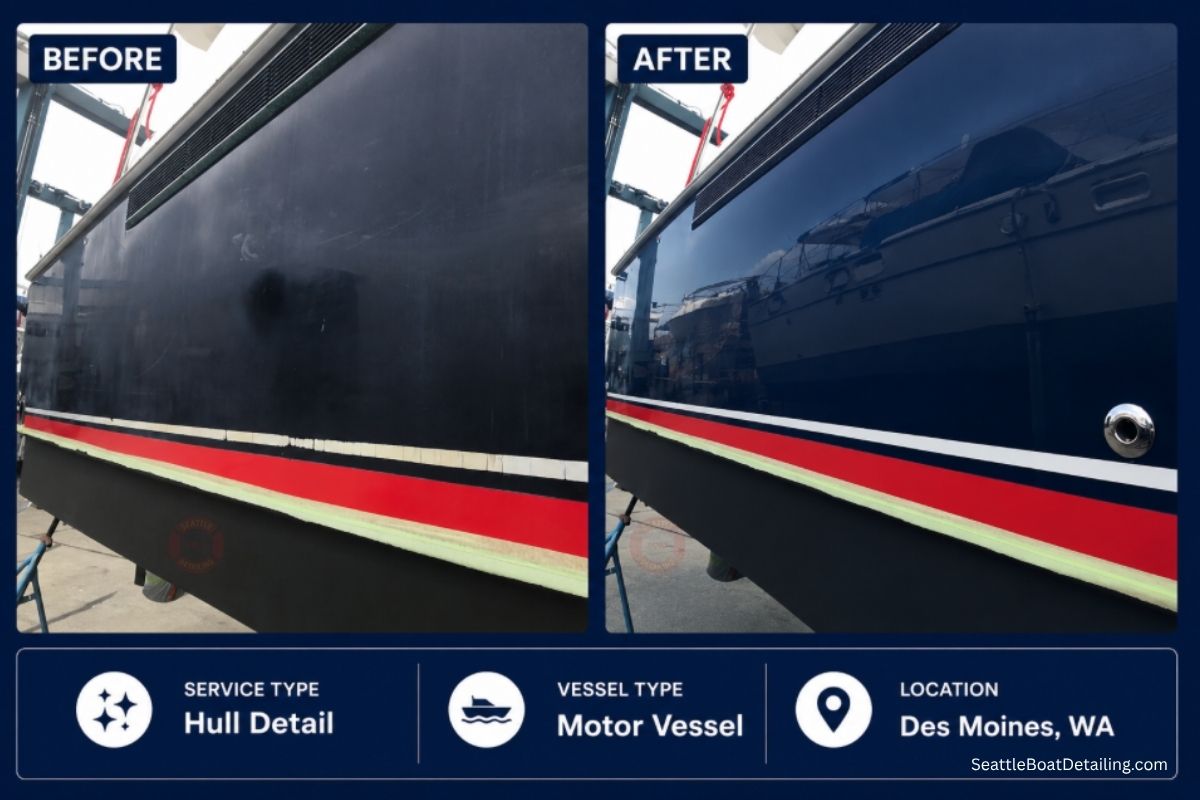
Many oxidized gelcoat surfaces can be significantly restored, but results depend on gelcoat thickness, prior correction, UV damage, color loss, and overall condition. Not every vessel will return to a mirror-like finish, and the safest correction level should be based on what the surface can realistically support.
Vinyl striping and decals behave differently from gelcoat. Mildly weathered graphics may sometimes be cleaned or improved, but cracked, dry-rotted, shrinking, peeling, or severely sun-damaged vinyl cannot simply be polished back to new condition.
We provide an upfront assessment before correction begins. If graphics are likely to be damaged by polishing or have reached the end of their useful life, we will recommend removal or replacement rather than overworking the surrounding surface.
Dockside Convenience &
When a Haul-Out May Be Needed
For many vessels, gelcoat oxidation correction can be completed at the marina slip, boathouse, storage location, waterfront home, or driveway when access and working conditions are appropriate. Mobile service allows the work to be performed where the vessel is already kept, reducing unnecessary transportation and scheduling steps for the owner.
Some projects may require a haul-out, particularly when access below the rub rail is limited, the vessel’s configuration restricts safe machine access, or the condition being addressed extends into areas that cannot be worked effectively while the boat is in the water.
Before Scheduling a Haul-Out
If your restoration requires boat-yard access, confirm in advance whether independent contractors are permitted on-site and whether the yard requires proof of insurance, vendor registration, advance authorization, or specific work-area rules. Confirming access before scheduling helps prevent delays once the vessel is hauled.
View Our Service Area →Protect Your Investment
Help Preserve the Finish
After Gelcoat Restoration
Once oxidation and contamination have been corrected, the renewed surface is again exposed to UV, salt, moisture, waterline buildup, and airborne contaminants. Applying an appropriate protective product helps preserve the corrected finish and reduces how quickly the surface is exposed to the same environmental stresses again.
For properly prepared surfaces, SiO2 ceramic coatings can provide strong water repellency, surface slickness, enhanced depth and gloss, and extended protection from normal marine exposure. Performance and longevity depend on the product used, surface preparation, vessel storage, use, washing practices, and ongoing maintenance.
Ceramic protection does not make gelcoat maintenance-free and does not guarantee that oxidation can never return. Its role is to help preserve a properly corrected surface and support easier ongoing care.
Ready to Address Your Boat’s Oxidation and Restore Its Finish?
Every vessel is different. Gelcoat condition, previous correction work, color, age, storage, access, and the depth of oxidation all affect the process required and the finish that can realistically be achieved.
How the Initial Estimate Works
To begin, provide the vessel’s year, make, model, approximate length, location, photographs, and a description of the areas you would like evaluated. This information helps us understand the scope of the request and prepare an initial estimate.
Final Condition Verification
All services are provided by estimate. Pricing varies based on the type of service, year, make, model, and condition, and is subject to verification of the vessel’s condition before work begins.